









Most manufacturers I meet treat the shipping carton as a cost line: the cheapest brown box that will not collapse before the truck arrives.
That is a mistake, and in African markets it is an expensive one.
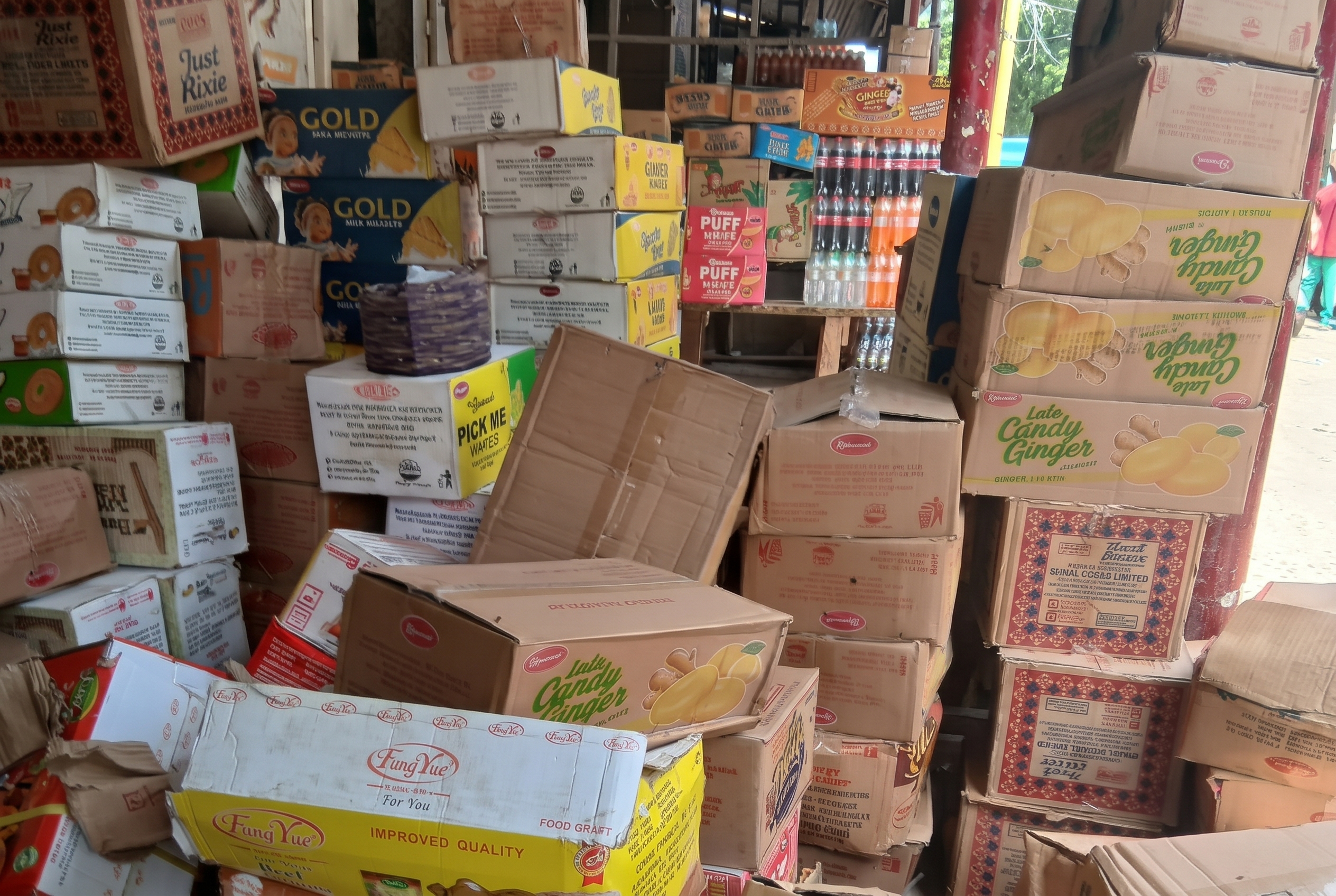
Before a consumer ever sees your product, a wholesaler, a loader, a truck driver and a shop owner have already met your carton. They decide whether it gets restocked, whether it gets trusted, and whether it gets copied. The carton is your first brand impression, and it is made on the people who control your volume.
Here is why that matters, with numbers, and what to do about it.
1. Your first customer is a trader, not a consumer
In most African markets, the informal trade is where FMCG volume moves.
-
Informal retail is estimated at 98% of retail sales in Nigeria, 96% in Ghana and 70% in Kenya (Smollan, 2022).
-
BCG data reported by Food Business Middle East & Africa puts Nigeria’s 600,000+ small retailers at 97% of national sales, and traditional retail at 82% in Morocco, 77% in Kenya and 75% in Egypt.
-
In Kenya, Nielsen found that traditional trade (kiosks and groceries) took 66.3% of FMCG spend in the year to March 2019, and that more than 70% of FMCG purchases were priced below KSh 55.
Different studies define “informal” differently, which is why the figures vary by source. The direction does not change. The buyer you must win first runs a kiosk, a stall or a small shop. They buy by the carton and break it down to sell in small units.
That trader judges your brand by what they can see and handle. That is the carton.
2. Follow the carton
A carton travels from factory to distributor warehouse, to wholesale market, to a truck or tricycle, to a shop, and finally to a stall. At each stop, someone is asking a question about your brand:
-
The wholesaler: Can I find it quickly in a stacked stall, and will it sell?
-
The loader and driver: Will it survive stacking, heat and rough roads?
-
The shop owner: Is this genuine, and will it move?
-
The counterfeiter: Is this easy to copy?
The last question is not a joke. It leads to the second job of a carton.
3. The four jobs of a carton
Job 1: Be seen
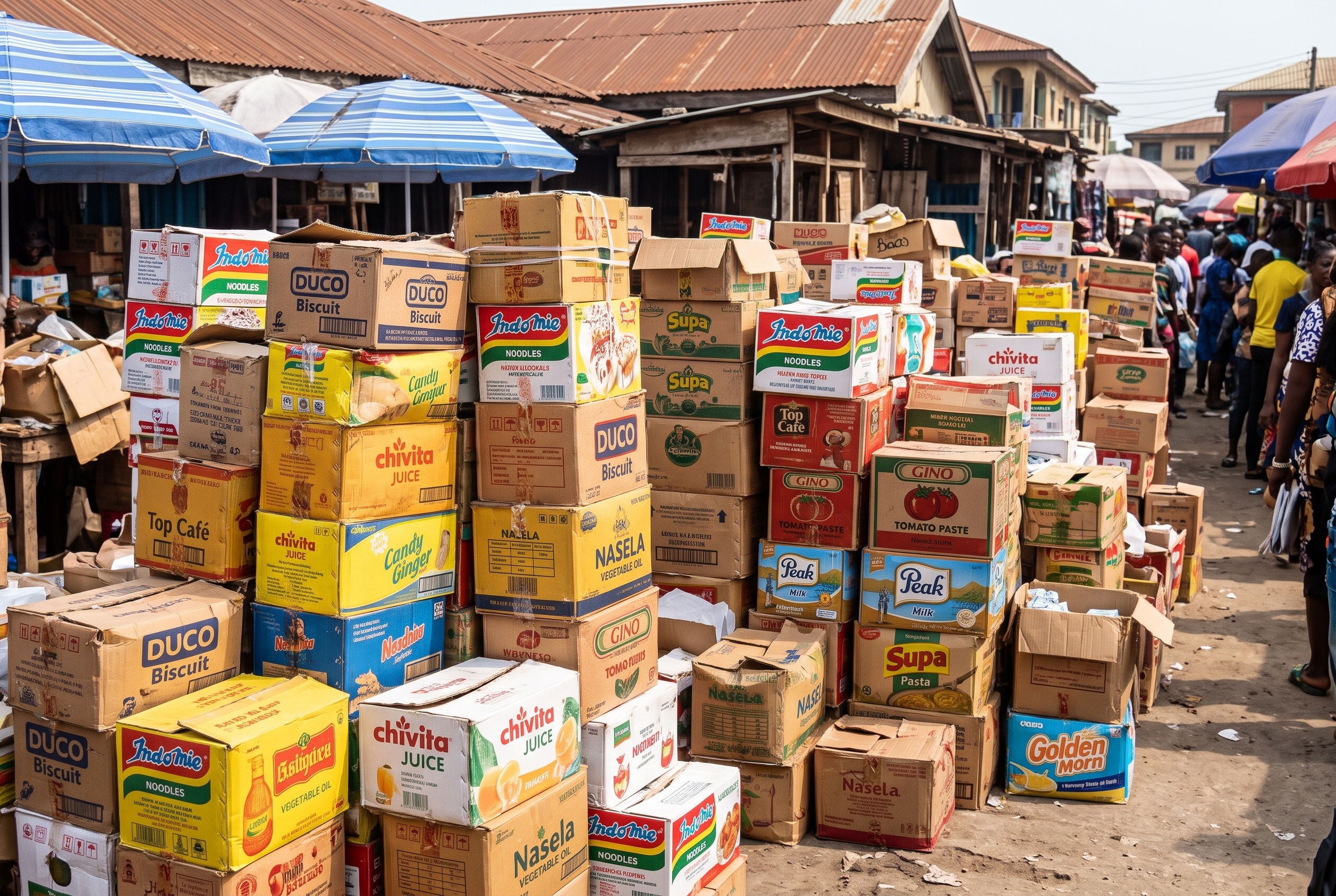
Wholesale stalls are crowded and goods are stacked, turned and mixed. A carton printed on one face only is invisible in most of the positions it will be stacked in. Brand colour, logo and product name should read from every side and from a distance.
Job 2: Prove it is real
Counterfeiters go after brands that sell, and they copy the packaging first.
-
In a NAFDAC operation in Eziukwu (Cemetery) Market in Aba, Abia State, more than 240 shops were found operating as makeshift factories using cloned packaging materials of reputable brands. Over 1,500 cartons of fake and substandard products were destroyed on site and about 300 more were taken to NAFDAC’s warehouse.
-
Nigerian consumers have shared that fake and genuine Peak milk sachets can look identical, and that the NAFDAC registration number and expiry date on the back were the only way they could tell the genuine one.
-
Sproxil, the mobile authentication company founded by Ghanaian entrepreneur Ashifi Gogo, has worked with more than 300 brands and verified about 2.5 billion items as authentic. Its founder noted that in Nigeria counterfeiters target successful household-name brands.
-
Regulators are moving. Nigeria’s FCCPC has set up an inter-agency committee, including SON and NAFDAC, to explore QR-based digital traceability. Kenya’s KRA introduced an app to verify QR-coded excise stamps on beer, wines, spirits and tobacco, after deaths linked to illicit alcohol, some of it carrying established labels.
A caution: a plain QR code is not security. Industry observers have pointed out that QR codes can be copied and pointed at fake pages. Authentication needs layers (unique codes, tamper evidence, print quality that is hard to replicate), and it needs the trader to know how to check.
A carton that is easy to clone is an open invitation to someone to damage your brand under your own name.
Job 3: Sell for you
In markets where there is no merchandiser and no shelf, the carton often becomes the display.
-
Mordor Intelligence estimates that sachets account for up to 50% of unit sales in Nigeria and Kenya, and that pack-size innovation is the main growth lever because of affordability.
-
That means your carton holds many small units that will be sold one by one. A carton that opens into a clean, branded display tray, or that keeps the inner packs visible and easy to pull, helps the trader sell your product instead of a neighbour’s.
-
Mordor also reports that die-cut corrugated designs are growing faster than the overall Middle East and Africa corrugated market as last-mile networks deepen.
This is my inference from the data: if most purchases are small and most trade is informal, the way a carton breaks down matters as much as the way it looks sealed.
Job 4: Survive the journey
A carton that arrives crushed, stained or faded tells the trader that your brand is careless.
There is a real cost trade-off, and I will not pretend otherwise:
-
Mordor reports that flexible pouches weigh 40 to 50% less than comparable corrugated cartons, a real advantage in logistics-heavy markets like Nigeria and Kenya.
-
Kraft paper supply and prices are volatile in Egypt, Nigeria and Kenya, and raw-material logistics carry import risk.
-
Single-wall board holds 48.2% of the Middle East and Africa corrugated market (2025). Most competing cartons are cheap and similar.
That last point is the opening. A carton that is better built and better printed than the stack next to it is a visible signal. But every upgrade has to be justified by what it does for sell-through, not by design preference.
4. A ground example: Indomie
Indomie, made by Dufil Prima Foods and distributed through the Tolaram Group, is a useful case. CNN reported in 2019 that Indomie held about 74% of Nigeria’s instant noodle market, and Business Day described it as present in every corner market stall in the country. Tolaram’s Nigerian business also grew from a 13-year wait to reach $10 million in revenue to near $1 billion in group turnover.
I am not claiming the carton built Indomie. Distribution did. My point is what distribution does to packaging: when a brand reaches that many stalls, its carton becomes the most repeated brand impression in the trade. Whoever controls the route to market controls how many times traders see your carton, and in what condition.
That is the lesson for a newcomer. You cannot design the carton first and think about distribution later. They are the same decision.
5. Five carton mistakes I see in African F&B
-
Designing in an office and never testing on a route. If it has not been stacked in a warehouse and driven on a bad road, it is a draft.
-
Printing one face only. Cartons get turned. Brand every side.
-
Using the carton to list a barcode and nothing else. The trader cannot read a barcode. They read colour, logo and product name.
-
Treating authentication as an afterthought. Add it before the copy appears, not after.
-
One carton for every market. Nigeria, Ghana and Cameroon are different markets. Cameroon alone is officially bilingual. Language, registration numbers and local compliance details belong on the carton.
6. The 10-minute carton audit
Put your carton in a stack of five competitor cartons and check:
-
Can you identify your brand from 10 metres, on any of its sides?
-
Is your regulatory registration number clearly visible?
-
If you saw a copy, would you be able to tell it was fake in 10 seconds? Could a trader?
-
Does it still look clean after a 300 km trip on a loaded truck?
-
Does it open into something a trader can sell from?
-
Does it carry the right language for that market?
If you cannot answer yes to most of these, your carton is a cost, not an asset.
7. Carton branding is a route-to-market decision
Packaging suppliers can print your carton. Designers can make it look good. Neither can tell you who touches it between your factory gate and the stall, which of those people decide whether your product is restocked, and where a counterfeit is most likely to appear.
That is a route-to-market question. It is the work I do with producers and product owners across West and East Africa: mapping how goods actually move, finding the people who control volume, and building market development plans where packaging, distribution and trade relationships point the same way.
If you are launching or relaunching a food or beverage product in Nigeria, Ghana, Cameroon, Kenya or beyond, send me a message. I will tell you what your carton is saying to the trade today.
References
-
Smollan, The New Informal (Nov 2022): informal share of retail in Nigeria, Ghana and Kenya. https://smollan.com/wp-content/uploads/2022/11/Smollan_The-New-Informal_Nov2022.pdf
-
Food Business Middle East & Africa, retail evolution in Africa (citing BCG): https://www.foodbusinessmea.com/?p=2097150
-
Business Daily Africa, “Kadogo economy rules retail sector” (citing Nielsen): https://www.businessdailyafrica.com/bd/corporate/companies/-kadogo-economy-rules-retail-sector-2257816
-
Mordor Intelligence, Africa Packaging Market 2026-2031 (sachet share, pack-size innovation): https://www.giiresearch.com/report/moi2124409-africa-packaging-market-share-analysis-industry.html
-
Mordor Intelligence, Middle East and Africa Corrugated Packaging Market (pouch vs carton weight, kraft volatility, board types, die-cut growth): https://www.mordorintelligence.com/industry-reports/middle-east-and-africa-corrugated-packaging-market
-
NAFDAC crackdown on counterfeit beverage cartel, Aba: https://kolaking.substack.com/p/nafdacs-major-crackdown-unveiling
-
Marketing Edge, consumer reports on fake and genuine Peak milk sachets: https://marketingedge.com.ng/?p=181293
-
Africa.com, on Sproxil and Ashifi Gogo: https://africa.com/top-10-news/ghanaian-entrepreneur-creates-tool-to-spot-fake-consumables
-
Securing Industry, on Nigeria’s FCCPC QR traceability committee: https://www.securingindustry.com/nigeria-looks-at-use-of-qr-codes-to-deter-counterfeiting/s111/a17016
-
Tralac, on Kenya’s KRA excise stamp verification app: https://tralac.org/news/article/10426-kra-steps-up-war-on-counterfeits-with-new-mobile-verification-app.html
-
CNN, on Indomie and Tolaram in Nigeria (2019): https://amp.cnn.com/cnn/2019/01/25/africa/indomie-giant-in-nigeria-intl/index.html
-
BusinessDay, on Tolaram’s growth in Nigeria: https://businessday.ng/?p=423440
Note on data: several figures date from 2019 to 2022 and are the most widely cited baselines available. Check for newer numbers before using them in client proposals.

Jean Claude Agbortem Obi is a business consultant specialising in market entry, business development and commercial expansion across African markets, with a particular focus on FMCG and pharmaceutical businesses.
Through Routrix Africa, he works with international and African companies seeking to navigate the complexities of African markets, including distributor selection, route-to-market development, market intelligence and commercial expansion.
His perspective is grounded in a practical understanding of the realities that determine whether a brand succeeds beyond the boardroom and reaches the consumer at the point of purchase.
His central philosophy is simple: African market entry should not end with getting into the market. The real objective is building a sustainable pathway to commercial success.