









A global consumer goods executive once told me proudly:
“Our brand has 78% weighted distribution across the leading modern trade chains. We’re in the market.”
My response was simple:
“Are you visible, or are you simply parked on a shelf?”
Six months later, the company was dealing with declining inventory velocity, cash tied up in slow-moving stock and growing pressure from the board to explain disappointing sales.
The problem was not necessarily consumer demand.
It was a more fundamental misunderstanding of how African retail markets work.
Presence is passive. Visibility is active.
For international FMCG companies entering or expanding across Africa, this distinction can determine whether a market-entry strategy produces sustainable growth—or simply creates inventory sitting inside the distribution system.
Presence Does Not Equal Market Penetration
Having a product inside a country, warehouse, supermarket or distributor’s network does not automatically mean consumers can find it, understand it, trust it or choose it.
There is a critical difference between distribution and commercial visibility.
Presence means:
- Your product has entered the market.
- A distributor has received the inventory.
- Your SKU has been listed by a retailer.
- Your product is physically available somewhere in the supply chain.
Visibility means:
- Consumers notice the product.
- Retailers actively recommend or display it.
- Traders have a commercial reason to give it space.
- The product is positioned where purchasing decisions actually happen.
- Replenishment happens because the product is moving.
That distinction matters enormously in Africa because retail is highly fragmented.
In Nigeria, for example, traditional and informal channels remain central to FMCG distribution. A World Bank analysis has previously estimated that traditional trade accounted for as much as 98% of FMCG flow in Nigeria, illustrating just how different the Nigerian route-to-market can be from markets dominated by organised retail.
More recent industry assessments continue to show the overwhelming importance of traditional trade, with one 2026 analysis estimating that more than 90% of FMCG sales in Nigeria occur through traditional outlets.
For an international brand, therefore, being listed in a supermarket is not the same as being present in the market where consumers actually shop.

The Modern Trade Visibility Trap
Modern retail can create a dangerous illusion of market penetration.
A brand may secure listings with major supermarket chains, invest heavily in trade terms and celebrate the number of stores carrying its products.
The distribution report looks impressive.
But then sales underperform.
Why?
Because shelf presence does not guarantee shopper attention.
A product can be physically available but commercially invisible.
Consider a supermarket aisle containing ten competing brands. Your product may technically be available, but if:
- it is placed below eye level;
- competitors occupy the premium shelf positions;
- there is no secondary display;
- the packaging does not stand out;
- the retailer’s staff do not recommend it;
- there is no promotional activation; and
- consumers have no reason to switch from an established alternative,
then your distribution percentage can look much healthier than your actual market position.
This is why FMCG executives should distinguish between weighted distribution and productive distribution.
The question should not simply be:
“How many stores stock our product?”
It should be:
“How many stores are generating repeat sales?”
That is a fundamentally different metric.
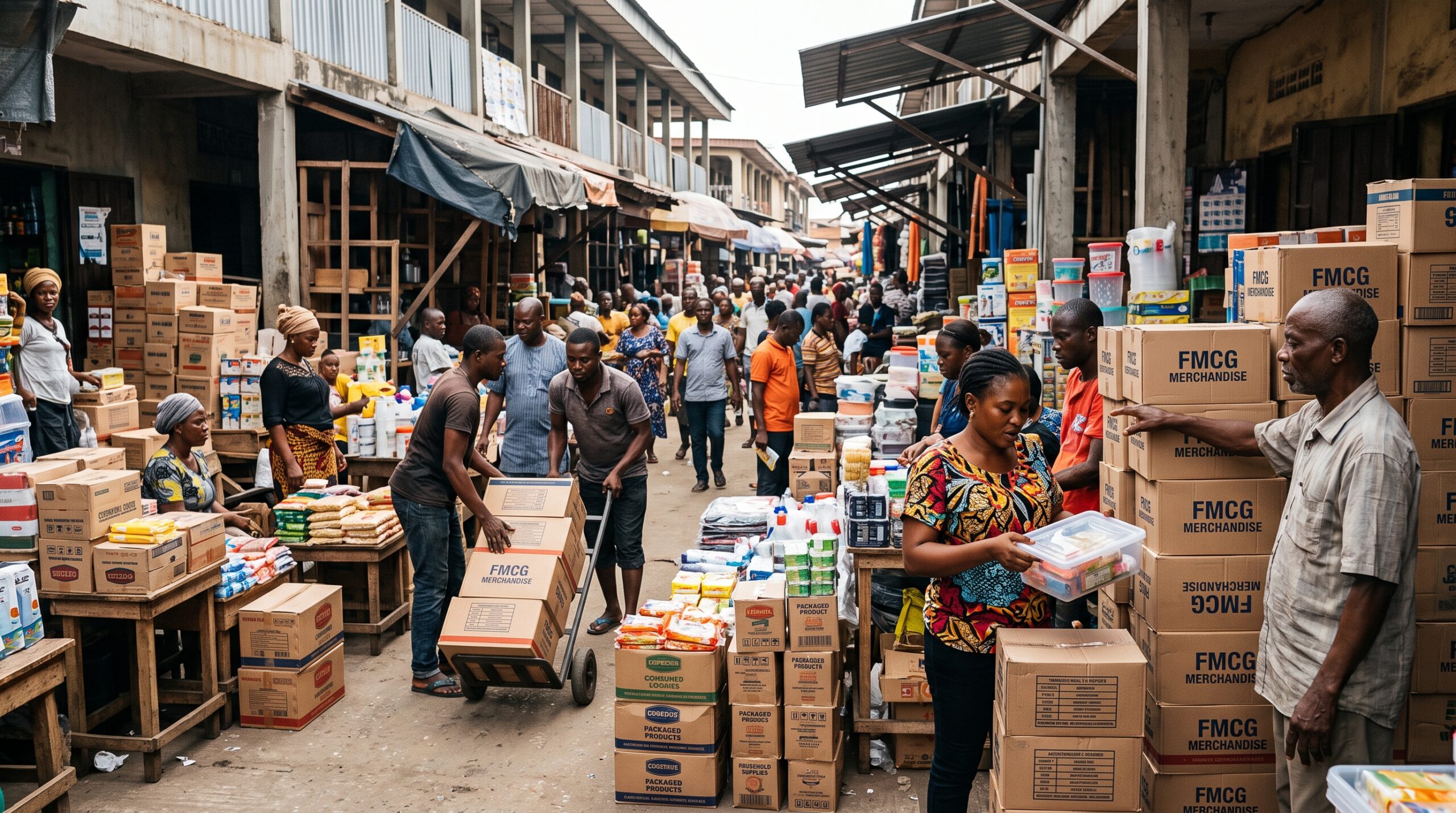
Africa’s Informal Retail Economy Changes the Rules
One of the biggest mistakes international FMCG companies make is designing an African route-to-market strategy around the assumption that modern retail is the centre of the market.
In many African countries, it is not.
Traditional retailers, neighbourhood shops, kiosks, open markets, independent wholesalers and other informal or semi-formal channels remain critical points of purchase.
The African Marketing Confederation notes that informal channels account for a substantial proportion of food sales across sub-Saharan Africa, with estimates outside South Africa ranging from approximately 40% to 90%, depending on the market.
Nigeria demonstrates this particularly clearly.
Research cited by Oxford Business Group estimated that Nigeria had around 600,000 small-scale retailers, while traditional and informal retailers accounted for a very large share of retail transactions.
This matters because the operating logic of a neighbourhood kiosk in Lagos is fundamentally different from that of a supermarket in a shopping mall.
The retailer may have limited shelf space.
The shopper may be buying one small pack rather than a family-size SKU.
Price sensitivity can be extreme.
Replenishment may happen daily or several times a week.
And the retailer’s decision about which brand receives the most visible position may depend heavily on how quickly that product converts into cash.
This is where visibility becomes a commercial strategy.
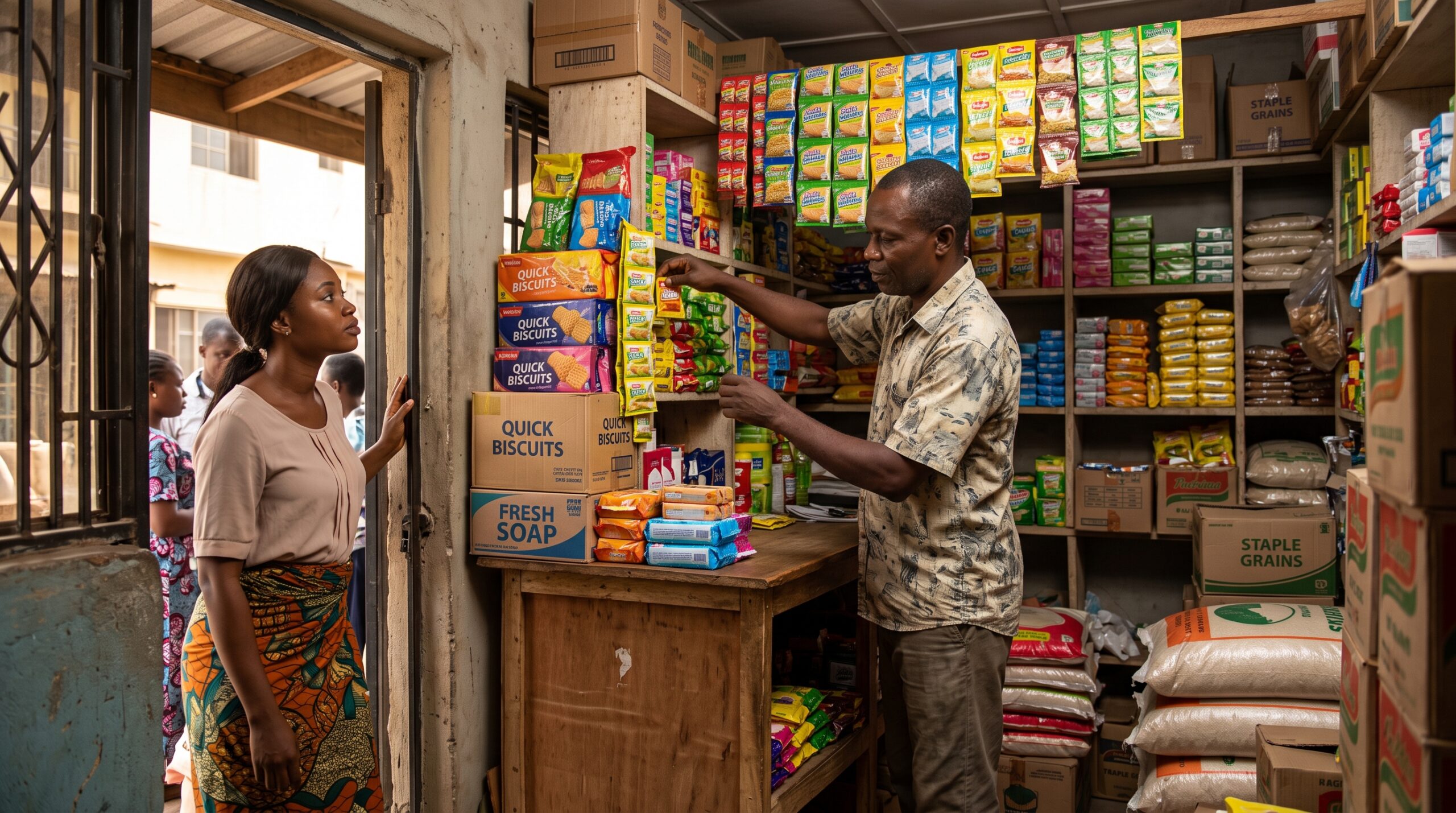
In Informal Trade, the Retailer Is Part of Your Marketing Team
International brands often think of marketing as advertising and trade marketing as promotions.
In African traditional trade, the retailer can become something much more important:
a distribution and marketing asset.
A kiosk owner deciding which detergent, beverage, snack, personal-care product or household item to place at the front of the store is making a commercial decision.
The product that moves quickly gets attention.
The product that provides an attractive margin gets attention.
The product that consumers specifically request gets attention.
The product supported by effective trade incentives gets attention.
This means retailer economics can directly influence brand visibility.
A brand that wants visibility therefore needs to understand:
- retailer margins;
- wholesale pricing;
- recommended retail pricing;
- stock rotation;
- minimum order quantities;
- promotional incentives;
- credit practices;
- replenishment frequency;
- competitor pricing; and
- outlet-level purchasing behaviour.
A distributor can deliver your products to a market.
But the retailer determines whether many of those products will actually become visible to consumers.
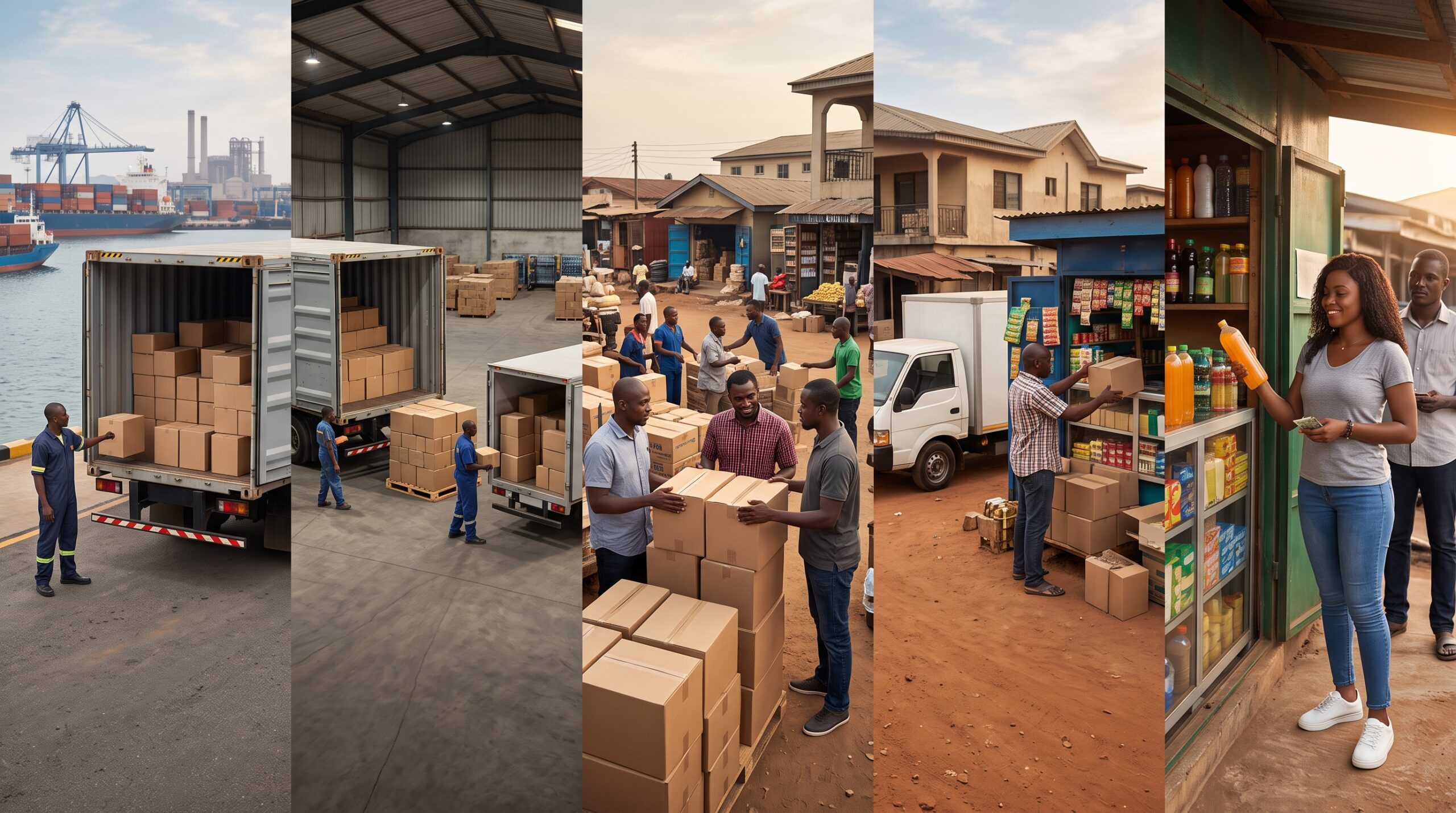
From Balogun to Neighbourhood Kiosks: Visibility Must Be Designed for the Channel
African retail markets are not homogeneous.
The merchandising strategy that works in a modern supermarket may fail completely in an open market.
Take major wholesale and retail hubs in Nigeria.
A product competing for attention in a dense trading environment cannot rely on a conventional corporate assumption that consumers will carefully compare every SKU.
Packaging, carton visibility, colour recognition, signage, point-of-sale materials and retailer recommendation can all influence whether a product is noticed.
In a crowded wholesale environment, visibility has to work at a distance and at speed.
The same principle applies further downstream.
A neighbourhood retailer may have only a small amount of physical space, meaning brands have to earn their position.
This is why FMCG companies expanding into Africa need to think beyond:
“How do we get the product into the country?”
The more important question is:
“How do we make the product move once it gets there?”

The Real KPI Is Velocity
This is where the distinction between presence and visibility becomes particularly important.
A distributor can tell you:
“We have stock.”
A sales report can tell you:
“We have distribution.”
But neither necessarily tells you whether the market is responding.
The stronger question is:
“How quickly is the stock moving?”
Inventory velocity tells you much more about the health of your route to market.
A product with broad distribution but weak rotation can become a working-capital problem.
A product with narrower distribution but strong repeat purchase can become a growth opportunity.
This is why international FMCG companies should monitor metrics such as:
- Numeric distribution
- Weighted distribution
- Sales per outlet
- Stock rotation
- Reorder frequency
- Outlet productivity
- Share of shelf
- Secondary display penetration
- Retailer margin
- Stock-out frequency
- Promotion effectiveness
- Regional sales velocity
These metrics provide a much clearer picture of whether market entry is actually working.
Visibility Is a Route-to-Market Strategy
The most successful FMCG companies operating in Africa understand that visibility cannot be left entirely to the distributor.
It has to be engineered.
That means designing the route to market around the realities of the country and category.
For an international brand, this may involve:
1. Mapping the real retail ecosystem
Understand where consumers actually buy—not simply where organised retailers are located.
2. Segmenting outlets
Not every retailer deserves the same investment.
High-volume wholesalers, strategic neighbourhood stores, modern retailers and smaller kiosks require different commercial approaches.
3. Designing retailer incentives
Retailer economics matter.
If your product gives the trader a compelling combination of margin, turnover and consumer demand, visibility becomes easier to achieve.
4. Building channel-specific merchandising
Modern trade, wholesale markets, pharmacies, independent retailers and kiosks should not receive identical visibility strategies.
5. Tracking outlet-level performance
Country-level sales figures can hide major problems.
A product may be performing strongly in Lagos while remaining almost invisible in other regions.
6. Connecting distribution with demand generation
Getting stock into the market is only half the job.
The other half is creating enough consumer and retailer pull to make that stock move.
Africa Does Not Need More “Shelf Presence”
Africa’s consumer markets offer enormous opportunities for FMCG companies.
But opportunity does not automatically translate into market share.
The companies that win will be those that understand the difference between entering a market and penetrating a market.
A distributor’s warehouse is not market penetration.
A supermarket listing is not market penetration.
A shipment arriving at a port is not market penetration.
Even widespread distribution is not enough.
Market penetration happens when the product is repeatedly noticed, purchased, replenished and recommended.
That is visibility translated into velocity.
The Strategic Imperative for International FMCG Companies
If you are entering Nigeria—or any other African FMCG market—do not make distribution coverage your only measure of success.
Ask harder questions:
Can consumers find us?
Can retailers make money from us?
Are we positioned where purchasing decisions happen?
Are our products moving quickly enough?
Are distributors actively developing the market or simply moving cartons?
Are we visible in traditional trade as well as modern retail?
Does our route-to-market strategy reflect how consumers actually shop?
These questions reveal the difference between a brand that is present and a brand that is winning.
The next generation of FMCG growth in Africa will not be built simply by putting more products into more stores.
It will be built by creating productive visibility at the point of purchase.
Stop Measuring Presence. Start Measuring Visibility.
If your FMCG strategy tells you how many outlets carry your product but cannot tell you where the product is visible, how quickly it moves and why retailers continue to stock it, you may have a distribution strategy—but you do not yet have a complete growth strategy.
Presence puts your product in the market.
Visibility gives the market a reason to choose it.
And ultimately:
Visibility creates velocity. Velocity creates repeat orders. Repeat orders create sustainable growth.
For international FMCG companies seeking to enter, expand or scale across Africa, the strategic challenge is therefore not simply getting products into the market.
It is building a route-to-market system that converts distribution into demand and demand into sustainable commercial growth.
If your company is preparing to enter the African market or is struggling to convert distribution into sales, Routrix Africa helps international and African businesses navigate market entry, distributor selection, route-to-market strategy and commercial expansion across Africa.
The objective is not simply to be present. It is to become commercially visible—and ultimately, impossible to ignore.

Jean Claude Agbortem Obi is a business consultant specialising in market entry, business development and commercial expansion across African markets, with a particular focus on FMCG and pharmaceutical businesses.
Through Routrix Africa, he works with international and African companies seeking to navigate the complexities of African markets, including distributor selection, route-to-market development, market intelligence and commercial expansion.
His perspective is grounded in a practical understanding of the realities that determine whether a brand succeeds beyond the boardroom and reaches the consumer at the point of purchase.
His central philosophy is simple: African market entry should not end with getting into the market. The real objective is building a sustainable pathway to commercial success.